How to have people over when your dog is reactive
Most advice for this is about managing the dog. The bigger lever is managing the guests, because they are the part you can actually give instructions to.
For most of the year you can arrange your life around this. You walk at off hours, you know which streets are quiet, you have a system.
Then it is December, and the thing you have spent eleven months steering around comes through your front door by invitation, eight people at a time, carrying dishes.
Most of what gets written about this is advice for the dog. Counter-conditioning, calm greetings, a mat to settle on. That work is real and it matters, and almost none of it is going to happen on the night, because you are hosting. You will be in the kitchen.
So this is written the other way round. The dog is the part of the evening you cannot instruct. Your guests are the part you can.
Should my reactive dog meet the guests at all?
Usually not, and I think the default should be separation rather than a managed introduction.
A gathering is close to the worst environment anyone could design for a dog who struggles with people. There are more of them than usual, they arrive in waves rather than once, they move unpredictably, some of them have been drinking, and the one person who knows the dog's signals is carrying a roasting tin.
That is a judgment rather than a rule, and there are dogs it does not apply to. If yours is mildly unsure of strangers and has a solid history of settling once people are seated, a careful introduction is reasonable. If yours has ever lunged, snapped or made contact with a visitor, the evening is not the night to find out whether that has changed.
One thing worth keeping in mind is who carries the cost of being wrong. If the introduction goes badly, your dog has a worse relationship with visitors than he started with, and you have a bite history. Neither of those is recoverable by Boxing Day.
Where should the dog actually be?
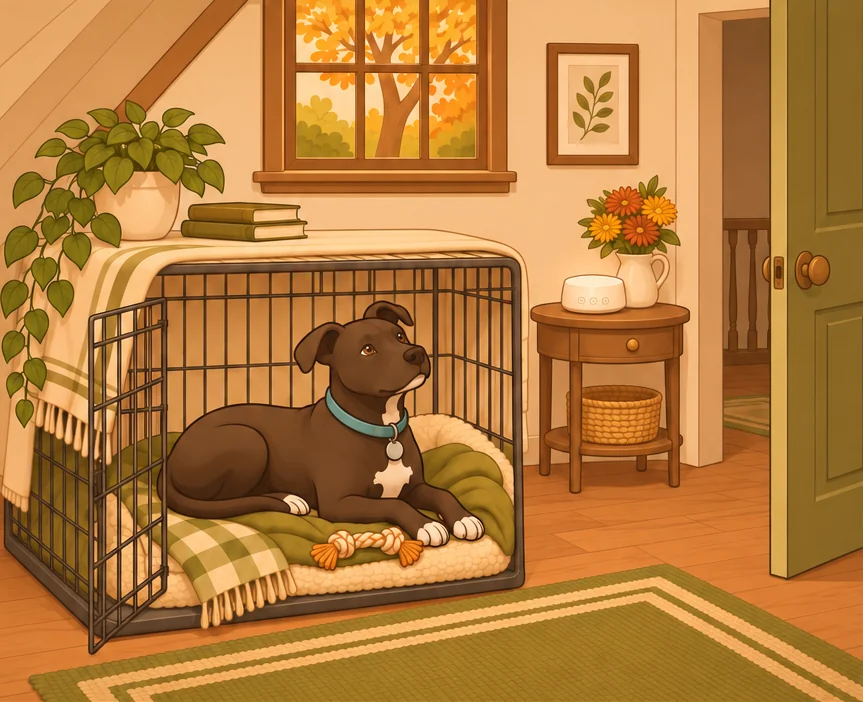
Behind a door, as far from the front door as the house allows, with something making noise.
The specifics matter more than people expect:
- A door, not a gate. A baby gate lets the dog watch the whole evening happen without being able to do anything about it, which is rehearsal rather than rest.
- Away from the front door and the hallway. The hallway is where arrivals, coats and goodbyes happen, and those are the loudest moments of the night.
- Sound to cover the sound. A fan, a sound machine, a radio. Not loud enough to be its own problem, just enough to blur the edges of a doorbell and a hallway full of people.
- Somewhere he already likes. Tonight is not the night to introduce a new room. If the back bedroom is somewhere he is shut for the first time all year, the room becomes part of the event rather than a break from it.
When should I put him away?
Before the first guest arrives, not when they are at the door.
This is the single change that makes the most difference and it costs nothing. A dog who is put away while the doorbell is going and voices are in the hall learns that the room is what happens when things get bad. A dog who was already in there, with a chew, twenty minutes before anyone turned up, is in a room where nothing has happened yet.
Same room, completely different meaning, decided by the order you did it in.
Practically that means being ready early, which is its own challenge on a day you are cooking. Set an alarm for thirty minutes before people are due.
What do I do about the doorbell?
Disable it, and tell people to text instead.
The doorbell is usually the sharpest single moment of the night, and it fires repeatedly over an hour as people trickle in. Tape over it, unplug it if it is wireless, or put a note on the door that says please text rather than ring or knock.
I would send that instruction with the invitation rather than relying on the note, because half of your guests will walk straight past a sign while holding a casserole.
What exactly should I tell my guests?
Be more specific than feels polite, and give the instruction rather than the explanation.
"He's friendly but a bit nervous" is the version most people send, and it is the version that causes the problem. It reads as a description of a personality, and it invites exactly the behavior you are trying to prevent, because the listener hears an invitation to be the one who wins the dog over.
Something closer to this works better:
Heads up before Thursday. The dog will be shut in the back bedroom for the evening and he needs to stay there. Please do not open that door, even to say hello, and please do not let the kids open it. Text when you arrive rather than knocking.
Three things that version does. It states where the dog is, so nobody opens the door by accident looking for the bathroom. It says what to do rather than describing the dog. And it names the specific failure, which is somebody deciding that saying hello would be nice.
In my experience the person who ignores this is almost never the one who is nervous around dogs. It is the confident one, the person who is good with dogs, who has had dogs all their life.
One thing worth keeping in mind is that the instruction lands better if it does not sound like a warning about a dangerous animal. You are not asking people to be afraid of your dog. You are telling them he finds parties hard, which is true, and which most people will respect once it is put as a fact rather than an apology.
Can I let him out later, once everyone has settled?
You can, and I think it is usually a mistake, which is a different thing.
By the time everyone has settled, three things have changed and all of them are worse. There is food at dog height on low tables. People are louder than they were at the start. And your dog has spent two hours listening to a houseful of strangers through a door, so he is not coming out fresh, he is coming out already wound up.
The version of him you are letting out is not the version you imagined when you decided it would be fine.
If he has to come through the house, for example to get to the garden, take him on a lead, go the shortest way, and come back the same way. Through and out, not a lap of the room.
What should he be doing while he is in there?
Something that takes a while to eat, given to him before the noise starts.
A chew or a stuffed Kong that occupies forty minutes does two useful things. It gives the first part of the evening, which is the loudest part, a job that is incompatible with patrolling the door. And it means being shut in that room reliably comes with something good.
Two cautions:
- Feed before the guests, not during. Handing a high-value chew to a wound-up dog through a half-open door, while a hallway full of people is audible behind you, is a worse moment than it sounds.
- If your dog guards food or chews, think carefully. A closed room, a valuable chew, and a guest who opens the door anyway is a specific and foreseeable way for somebody to get bitten. For a guarding dog I would use something lower value, or feed it before people arrive and take the remains out.
What does a good night look like?
Nothing. That is genuinely the answer, and it is worth saying out loud because it does not feel like success.
There is no moment where the dog is brilliant with everybody. There is no story at the end. The dog spent the evening asleep in a back room with a radio on and nobody thought about him, which is the entire goal.
It is worth deciding in advance that this counts as it going well, because otherwise the evening can feel like a failure for no reason other than that nothing happened.
What about the second gathering three days later?
This is the part people get caught by, and it is where I would push back on some of the advice you will read elsewhere.
The common version says a dog's stress hormones take 72 hours to return to baseline, so you should leave three clear days between demanding events. The number gets repeated everywhere, including by people whose advice I would otherwise take.
I went looking for where it comes from and could not find a primary source for it. I am not saying it is wrong. I am saying I could not find anybody who could show me the study, and I would rather tell you that than pass the number along as though I had checked it.
So I would not plan your December around it.
What does seem fair to say is narrower and still useful. Dogs differ a lot in how quickly they come down. A dog who had a hard Thursday is a worse bet on Saturday than the same dog would be on an ordinary week. And the holidays stack events in a way the rest of the year does not, so by the third gathering you may be dealing with a dog who has not had a normal week since November.
The honest problem is that you cannot tell which kind of dog yours is from a general rule, and you will not remember accurately in January what December looked like.
Which is the one thing I would actually ask you to do: write it down on the night. What time he settled, whether the sound machine helped, how he was the next morning, how he was two days later. Four lines.
Next December you will be making the same decisions again, and the difference between guessing and knowing is whether anybody wrote down what happened the last time.