What your dog can and cannot eat at Thanksgiving
Every list tells you to skip the onions. Almost none of them say why, or how much, which is the part that decides whether anyone actually listens.
Somebody is going to give your dog something off the table. It might be your father-in-law, it might be a child nobody is watching, and if the day goes long enough it might be you.
Most people read the usual list, nod, and hand over a piece of turkey anyway, because a list of rules with no reasons attached loses an argument with a dog who is looking at you. So this is the same list with the reasons put back in, and with some honest numbers, because some of these are dangerous in a mouthful and some only in a bowlful.
If something has already been eaten, skip to the bottom. None of this replaces a phone call.
What is actually dangerous, in one table
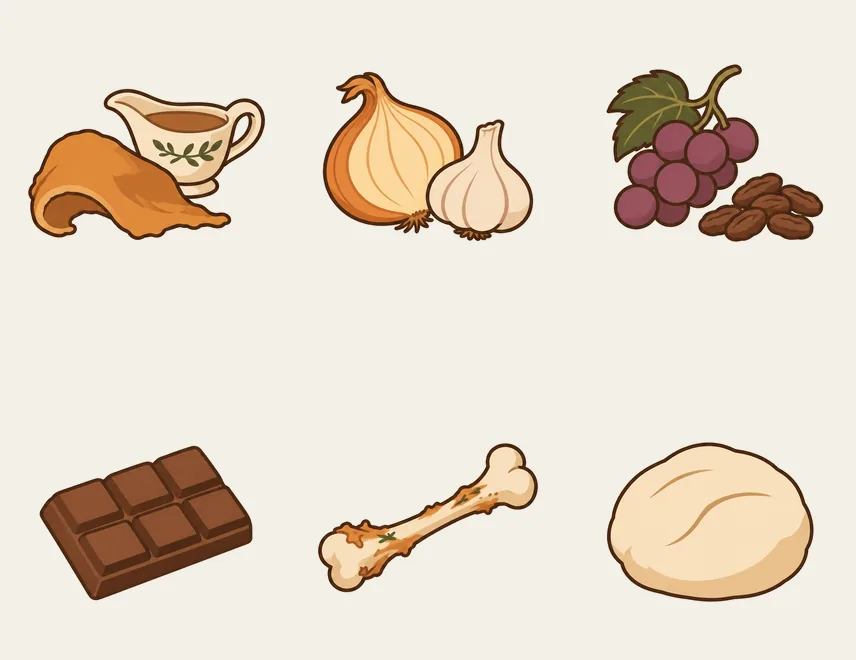
| Food | Why | How much |
|---|---|---|
| Fat: skin, gravy, drippings | Pancreatitis | One rich serving can do it |
| Onion, garlic, leeks, chives | Anaemia, 3 to 5 days later | 15 to 30 g raw onion per kg |
| Grapes and raisins | Kidney failure | 1 per 10 lb. No safe amount |
| Chocolate | Heart effects, seizures | Depends on type, see below |
| Xylitol or "birch sugar" | Blood sugar crash, then liver | 450 mg for a 10 lb dog |
| Macadamia nuts | Weakness, tremors | A small handful |
| Cooked bones | Splinter, can perforate | Any |
| Raw yeast dough | Bloat, plus alcohol poisoning | Any |
Fat is first because it is the one that fills emergency clinics, and it is the only entry here that is not a poisoning.
What is the most likely way a dog gets hurt at Thanksgiving?
Not poison. Fat.
What fills emergency clinics this week is pancreatitis, and it is not a toxin. It is an organ used to a measured scoop of the same food every day, suddenly handling turkey skin, drippings and gravy.
Watch for: repeated vomiting, a hunched back or tucked-up belly, pain when you touch the abdomen, refusing food, lethargy. It ranges from mild to life-threatening, and the difference is often how early it is caught.
One thing worth keeping in mind is that this risk scales with how many people are in your house. One person slipping him one piece of skin is nothing. Nine people each slipping him one, none of whom know the others did it, is a different meal entirely.
Why are onions and garlic dangerous for dogs?
Because the damage does not show up for days, so nobody connects it to the meal.
The sulfur compounds oxidise a dog's red blood cells, the body destroys them, and the result is anaemia. The destruction usually happens three to five days after eating, and the dog only looks unwell once enough cells are gone.
So the feedback loop is broken. Somebody gives the dog gravy on Thursday, the dog is fine on Thursday night, and everyone concludes gravy is fine. The tiredness and pale gums on Monday get blamed on a long weekend.
Two things that surprise people:
- Cooking does not help. Toxicosis has been reported after raw, cooked, dehydrated and granulated onion.
- Powder is worse than the vegetable, because a teaspoon of onion powder is a lot of onion.
On dose, it takes more than people fear and less than they hope. For a 60 lb dog, 15 g/kg is roughly three medium onions in one sitting, which will not happen by accident. For a 10 lb dog it is closer to half an onion, which absolutely could. So I would not panic about one lick of gravy, and would take seriously a small dog in the stuffing, or any dog eating leftovers for four days.
The practical problem is that onion and garlic are in nearly everything savoury on the table. It is easier to treat that whole half of the meal as off limits than to audit it dish by dish.
Can dogs eat grapes or raisins?
No, and unlike onions there is no safe amount.
Tartaric acid is the suspected culprit, and dogs appear to lack the means to clear it, so it accumulates in the kidney. Vomiting or diarrhoea typically appear 6 to 12 hours in, and kidney failure can develop within 24 to 72 hours.
At the holidays the risk is rarely a bowl of grapes. It is raisins hidden in things: stuffing, fruitcake, mince pies, cinnamon rolls, trail mix, and the cheese board.
Is chocolate really that bad, or is that overblown?
Real, and the type matters far more than most people realize.
| Type | Methylxanthines per gram |
|---|---|
| Cocoa powder | 28.5 mg |
| Unsweetened baking chocolate | 15.5 mg |
| Dark and semisweet | 5.3 to 5.6 mg |
| Milk chocolate | 2.3 mg |
| White chocolate | 0.04 mg |
Mild signs start around 20 mg/kg, heart effects at 40 to 50, seizures at 60 and above. Theobromine has a half-life of about 17.5 hours in a dog, so it accumulates.
Run the arithmetic and baking chocolate is roughly seven times the problem milk chocolate is, gram for gram. The half-eaten advent calendar is usually a bad evening. The unsweetened baking squares left out for the brownies are the emergency.
Signs normally start 6 to 12 hours after eating and can last up to 72 hours.
What is xylitol, and where is it hiding?
A sugar substitute, sometimes labelled "birch sugar", dangerous in amounts small enough to belong in its own category.
It triggers a large insulin release, so blood sugar crashes. Above roughly 100 mg/kg it causes hypoglycaemia; above roughly 500 mg/kg some dogs develop severe liver injury. For a 10 lb dog, 100 mg/kg is about 450 mg, which is a very small amount of a sugar-free product.
Signs can appear within 30 minutes, or be delayed 12 to 18 hours if it was in something slow to release like gum. Liver injury may not show for 24 to 48 hours.
The holiday vectors are sugar-free baked goods brought by a guest being thoughtful about somebody's diet, and peanut butter. Check the jar before it goes in a Kong, every time, including the jar you have used for a year, because manufacturers reformulate.
What about turkey bones and raw dough?
Cooked bones splinter. Raw dough keeps growing after it is swallowed.
Cooked poultry bones are brittle in a way raw ones are not, and fragments can perforate. The carcass left on the counter to cool is the classic one, so put it somewhere with a door rather than somewhere high.
Raw yeast dough is worth knowing about because the usual advice to just watch him is wrong here. The dough keeps rising in the warmth of the stomach, which distends it and can compromise the blood supply to the stomach wall, and in a deep-chested dog it can set off a torsion. Meanwhile the yeast ferments and produces ethanol, causing genuine alcohol poisoning. The deaths are usually from the alcohol rather than the distension.
Rolls proving under a tea towel on a low counter is exactly the setup.
Can dogs have macadamia nuts?
No, and they are the one here whose mechanism nobody has worked out.
Signs appear at 2.4 g/kg, a small handful for a medium dog. Within 12 hours a dog can be weak, wobbly, trembling and running a temperature, with the hind legs often worst. It usually resolves on its own in 12 to 48 hours, which makes macadamias frightening to watch and less dangerous than they look. Still a vet call, because weakness and tremors have other causes you would not want to assume away.
What can I actually give him?
Plenty, as long as you take it off the plate before the plate becomes a meal.
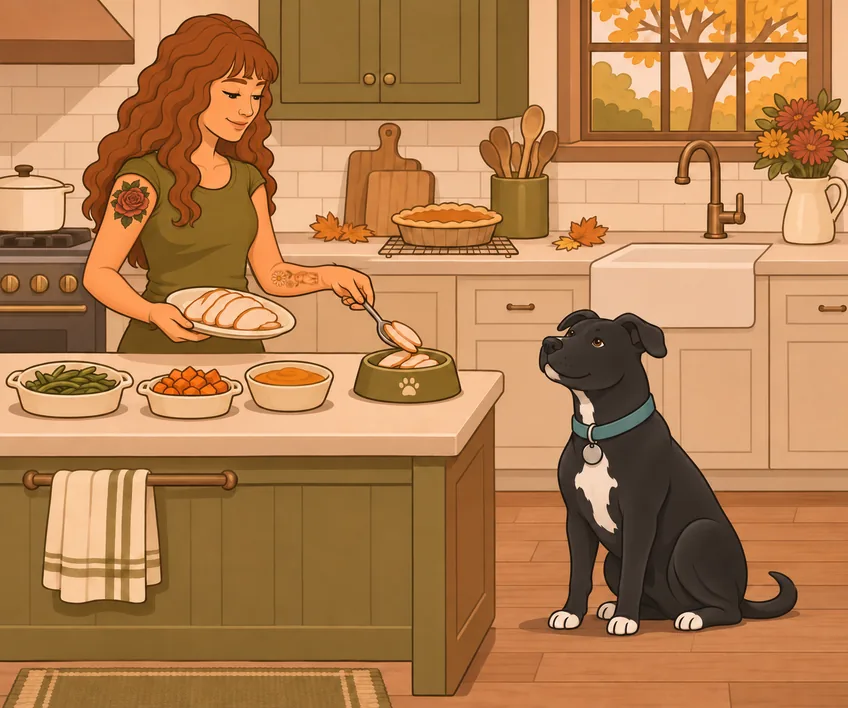
- Plain turkey meat. No skin, no bones, nothing from the cavity, nothing that sat in the gravy.
- Plain cooked green beans, carrots or sweet potato, set aside before the butter, brown sugar, marshmallow or bacon.
- Plain pumpkin purée, which is not the same tin as pie filling. The filling has sugar and spices, and nutmeg in quantity is its own problem.
- Plain mashed potato, if it was set aside before the butter, cream and garlic.
The pattern is that the dog-safe version of almost everything is the version you take out before it gets good.
One thing worth keeping in mind is that even safe food in quantity is a sudden change of diet for an animal who eats the same thing daily, so a dog who has had a polite amount of plain turkey can still have a bad night at the other end.
What do I do if he has already eaten something?
Call somebody now rather than reading another list.
Call your own vet first. If they are closed, call the emergency clinic you would use, or one of these. Both are open on the holiday, which is the point of them.
| Line | Number | Fee |
|---|---|---|
| ASPCA Animal Poison Control Center | (888) 426-4435 | A consultation fee may apply |
| Pet Poison Helpline | (855) 764-7661 | $99 per incident, follow-ups included |
Both are staffed 24 hours a day, 365 days a year.
Have ready: your dog's weight, what he ate, roughly how much, and what time. The weight and the time are the two that change the advice, and the two people fumble for.
Do not make him vomit unless you have been told to. Hydrogen peroxide gets recommended constantly online, it can damage the stomach lining, and for some substances bringing it back up is worse than leaving it down.
One thing worth doing before the day rather than during it: put both of those numbers and your vet's out-of-hours line in your phone now, as contacts, with your dog's weight in the notes field. The version of you who needs them will be standing in a kitchen full of people, and that is not the moment to be looking things up.
The rule that actually works
If I had to give one piece of advice instead of all of the above, it would not be about food.
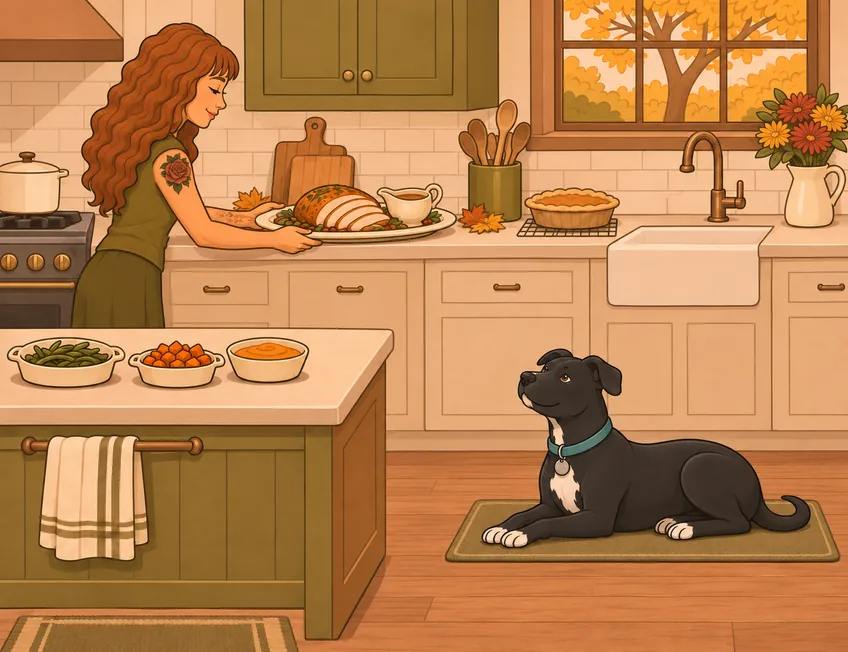
Decide in advance that one named person is allowed to give the dog anything, put what he is allowed into a bowl on the counter before anyone arrives, and tell everyone else, out loud, once, that the bowl is the only thing he gets.
The reason is in the first section. Almost none of these problems come from somebody making a reckless decision. They come from nine people each making a small kind one, independently, with no way of knowing what the others already did.
You cannot supervise a dog and host a dinner at the same time. You can set a rule for the humans before the humans arrive.