What reactivity actually is, and what it is not
Lunging and barking on leash is usually a distance problem, not a dominance problem. Why that distinction changes what helps.
Most people meet the word "reactive" right after something embarrassing has already happened. Your dog saw another dog across the street and went off like an alarm, and someone looked at you.
If that is where you are, the first useful thing to know is that reactivity describes a behavior, not a temperament.
It means your dog responds to something at an intensity that seems out of proportion to the thing itself. It is a description of what you saw, not a diagnosis and not a character assessment.

Why does my dog bark and lunge on leash?
Most of the time, a reactive display on leash is a request for more space.
Your dog has noticed something it finds difficult and it cannot move away, because it is attached to you by six feet of nylon. Barking and lunging are what is left when leaving is not an option.
Which is why I think the most useful thing you can learn is your dog's threshold distance: how close the trigger can get before your dog stops being able to cope. Below that distance, training works. Above it, you are both just getting through the moment.
One thing worth keeping in mind is that threshold moves. It shifts with the weather, with how much sleep your dog got, with whether the trigger is coming toward you, and with how many hard things already happened that day. A dog who handled a passing dog at thirty feet on Tuesday may not manage sixty feet on Saturday, and that is not a setback.
Is reactivity a dominance problem?
It is not, and this is one worth being firm about.
The idea that a lunging dog is asserting rank over you, or over the other dog, comes from a model of wolf behavior that the researcher who popularized it later spent years asking people to stop citing. It persists because it offers a simple story and a simple fix, and both are wrong.
What makes it worse than merely wrong is the fix that follows from it. That fix is almost always a correction, and a correction teaches your dog that the other dog's arrival predicts something unpleasant. Which tends to make the next encounter harder, not easier.
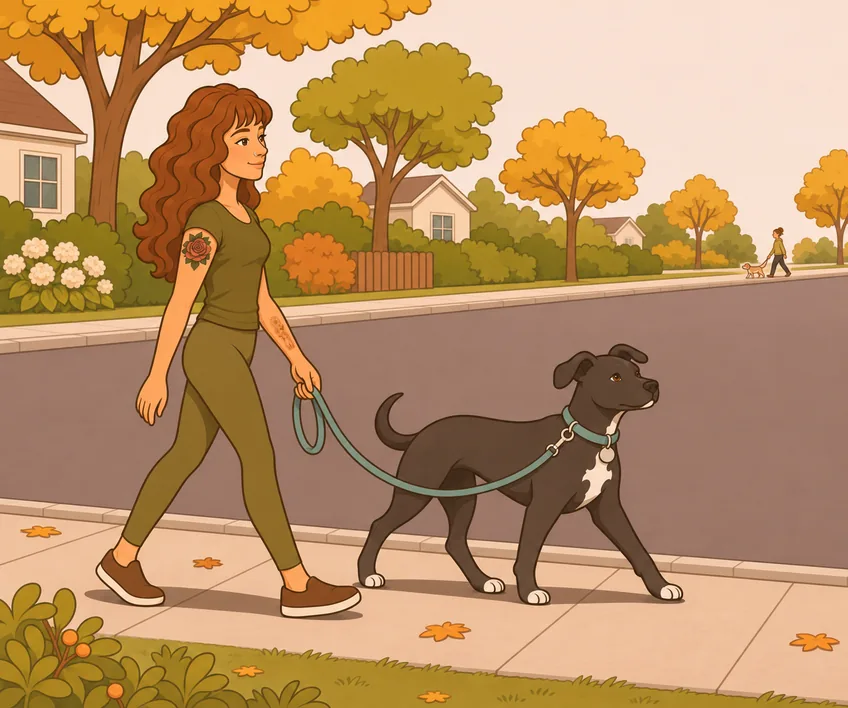
Is a reactive dog an aggressive dog?
Not necessarily, and the two get run together constantly.
Plenty of reactive dogs have never bitten anything and never will. Some reactive displays are fear. Some are frustration at not being allowed to go and say hello, and from the end of a leash those two look almost identical.
They need different handling, which is the main reason it is worth working out which one you have before you pick a plan.

Did I cause my dog's reactivity?
Almost certainly not, and I think it is the wrong question to spend energy on.
Genetics, early socialization, one bad experience, pain, or some combination of all of it. Owners arrive carrying a lot of guilt about this and it is rarely warranted.
What does change things is what you do next, which is a much better place to put the energy.
How common is reactivity?
Common enough that it is one of the most frequent reasons people call a trainer.
If it feels like your dog is the only one, that is partly because most people walk their reactive dogs at hours when nobody is watching. You are not seeing them, and they are not seeing you.
Why does tracking reactivity help?
Reactivity feels random when you are inside it, and it usually is not.
The pattern is just hard to see from memory, because the bad days are vivid and the uneventful ones disappear.
Writing down what happened, how close it was, how strong the reaction got and what helped turns a feeling into something you can look at. People regularly find that the thing they were certain was the trigger was not, or that the real variable was the time of day, or the week after a vet visit.
That record is also the most useful thing you can hand a trainer in a first session. "He is reactive to dogs" is a starting point. "Nine incidents in fourteen days, all between four and six in the evening, all at under twenty feet, and he recovers in about two minutes if we cross the road" is a brief.
Worth setting your expectations before you start: the first couple of weeks of logging usually look like noise. The pattern tends to show up in the third, which is roughly the point most people would have given up.
When should I see a vet or a behavior professional?
If your dog's reactions have involved a bite, or any injury, that is the point to bring in a veterinarian and a credentialed behavior professional rather than working from articles. What to ask them matters more than how quickly you book.
Pain is an underdiagnosed contributor and it is worth ruling out early. A dog that hurts has a shorter fuse, and no amount of training fixes that.
For everything else, start by measuring. You cannot change a pattern you have not seen.