The dog who cannot be left
Separation anxiety is a panic disorder, not disobedience. Why the usual advice to ignore it tends to fail, and what actually moves the needle.
You leave. Within ninety seconds the barking starts, or the scratching at the door, or the pacing that a neighbor mentions in a way that makes clear it has been going on for hours.
Most advice for this is some version of "do not make a fuss when you leave". That advice is not wrong exactly, and it is nowhere near enough, because it treats the problem as a habit when it is much closer to a panic attack.
What is separation anxiety?
Genuine separation anxiety is panic triggered by being alone. Not boredom, not protest, not spite.
The physiological state is the same one a person has in a panic attack: heart rate up, unable to settle, unable to eat, unable to take in new information.
That last point is the practical one, because a panicking animal cannot learn. Any plan that depends on your dog working something out while alone and distressed is working against the biology.
Is my dog anxious or just bored?
They look similar through a door and they need opposite plans, so it is worth separating them early.
A bored dog settles eventually, chews something interesting, and is fine once exercised or given a job. A panicking dog does not settle, often will not touch food however good it is, and the distress starts within minutes of the door closing rather than building over hours.
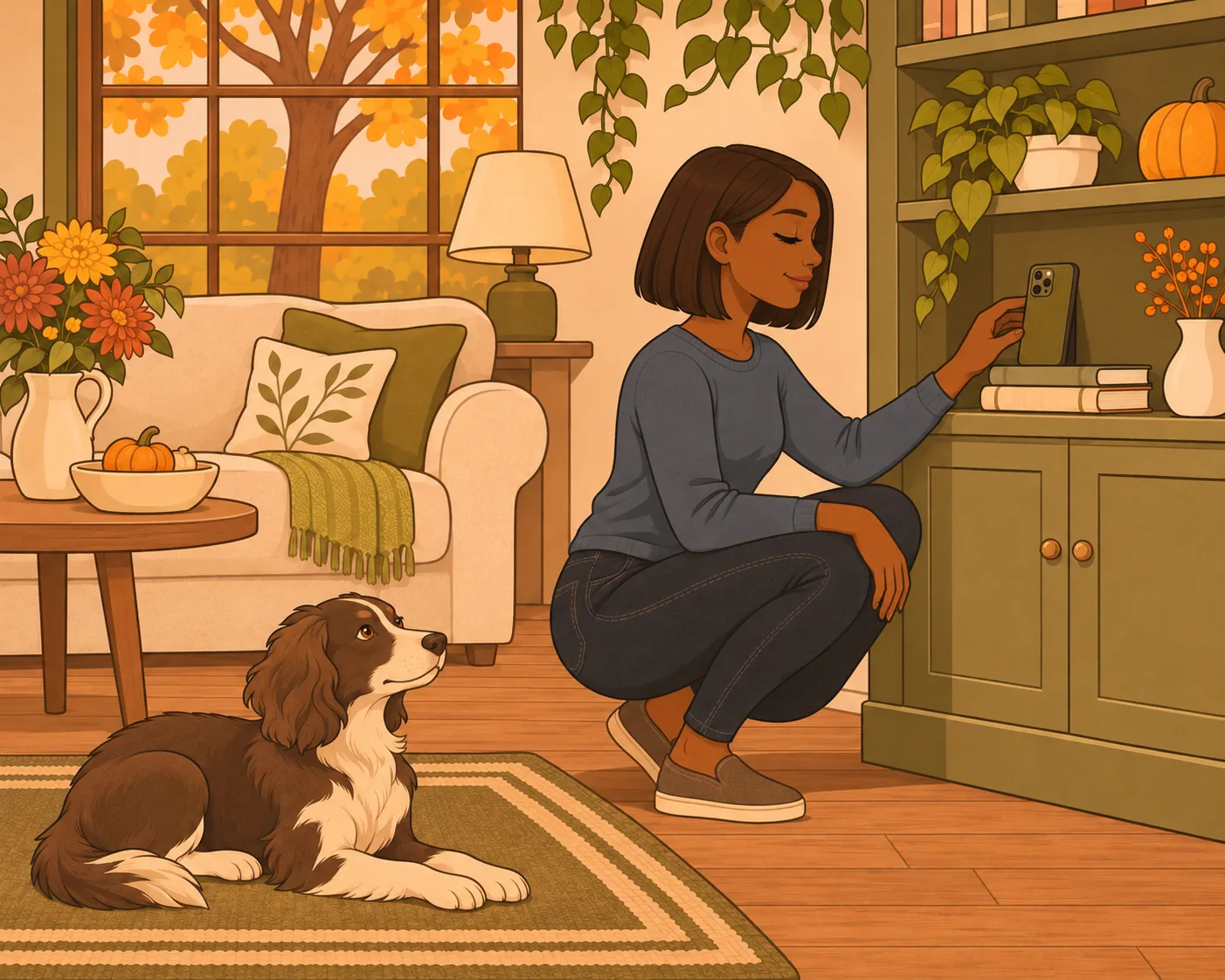
The cheapest way to find out is a camera. Put a phone on a shelf, leave for twenty minutes, and watch it back. People are surprised in both directions: some find a dog who barked twice and then slept, and some find ninety seconds of quiet followed by an hour of pacing they never knew about.
One thing worth keeping in mind is to film an ordinary departure rather than a staged one. Dogs read the difference, and a day you leave specially in order to record it will not look much like a Tuesday.
Does leaving the television on help?
Rarely, on its own.
Background noise, a worn t-shirt, a food toy and a well-exercised dog are all reasonable things to try, and none of them addresses the trigger, which is absence. They help a dog who is mildly unsettled. They do not help a dog who is panicking.
A food toy your dog will not touch is useful information rather than a failed attempt, so it is worth writing down rather than throwing out.
The same goes for getting a second dog. It sometimes helps and it sometimes produces two anxious dogs, and I think that is an expensive experiment to run on a hunch.
What actually works?
The approach with the best support behind it is unglamorous: absences short enough that your dog never panics, repeated, and lengthened very gradually.
That means finding the duration your dog is genuinely fine with, which for some dogs is closing the door for ten seconds, and building from there in increments small enough that nothing goes wrong. Progress is a dog who stays relaxed, not a dog who endures. Going back a step after a bad day is normal and is not lost ground.
The hard part is not the technique. It is that during the weeks this takes, your dog should not be left for longer than they can handle, which usually means a sitter, a neighbor, daycare or a rearranged schedule.
That is where most plans fail, and I want to be honest that it is harder than it sounds. Finding boarding that actually worked for our dog took longer than finding the right trainer had, and having a stranger come into the house was not an option for us at all. If that is your situation too, the coverage problem is the one to solve first, before the training plan rather than alongside it.
Should I talk to my vet about medication?
Yes, and I think earlier than most people do.
Separation anxiety is one of the areas where medication has a real evidence base, and there is a persistent idea that reaching for it is giving up or papering over something. A panicking animal cannot learn, so for some dogs medication is what makes the training possible rather than a substitute for it.
That is a conversation for a veterinarian, ideally one who sees behavior cases. One thing worth raising at the same visit is whether pain could be contributing, because discomfort that only matters when a dog is alone and unoccupied is easy to miss.
What should I record?
The time you left, the time distress started, how long it lasted and what you had tried that day.
As with reactivity on walks, the number that matters most is a gap you can measure. The gap between leaving and the first sign is that number, because it tells you where to start and whether you are making progress. It is also almost impossible to estimate from the other side of a door, which is why the camera matters.
A log that shows distress starting at ninety seconds in week one and at eleven minutes in week six is the clearest evidence you will get that something is working. It is also the single most useful thing you can put in front of a vet or a behaviorist.