Fireworks, thunder, and the dog who cannot settle
Noise fear is the most common fear in dogs and the one most often left untreated. What helps on the night, what to stop doing, and the question to ask your vet first.
There is a particular kind of evening that people who live with a noise-fearful dog know well. The first bang goes off somewhere two streets away, and the dog is already up, already panting, already looking for somewhere to put himself. And then it carries on for four hours.
If you are reading this in the week before New Year's Eve or the Fourth of July, you have not left it too late to help. But most of what works is decided before the first bang, not after.
Why is my dog so scared of fireworks?
Because fireworks are loud, sudden, unpredictable in timing, and come with flashes and vibration, which is close to a complete list of the things that frighten a mammal.
Thunder, gunshots, construction and garbage trucks sit in the same category for the same reasons. A dog cannot learn the schedule, cannot see what is making the noise, and cannot get away from it. Every bang is new.
This is not a training failure and it is not a sign of a nervous or badly raised dog. It is a reasonable response to something genuinely alarming that your dog has no way to predict or escape.
How common is fear of loud noises in dogs?
More common than almost anyone realizes, and most of it never gets treated.
Researchers at Bristol interviewed almost a thousand owners and found that nearly half reported their dog showing at least one fear response to noises. Only about a quarter of owners described their dog as fearful of noise at all, and fewer than a third of those had ever sought professional advice about it.
That gap is the useful part. Half of dogs show it, a quarter of owners name it, and fewer still get help. If this is your dog, you are not dealing with something rare. You are dealing with the most common fear in dogs and the one most likely to be quietly tolerated for years.
Should I comfort my dog during fireworks?
Yes. The idea that comforting a frightened dog rewards the fear and makes it worse is wrong, and it is one of the more harmful pieces of advice still in circulation.
You can reinforce a behavior. You cannot reinforce an emotion. Fear is a state, not a trick your dog is performing for attention, and sitting with a frightened animal does not teach it to be more frightened next time.
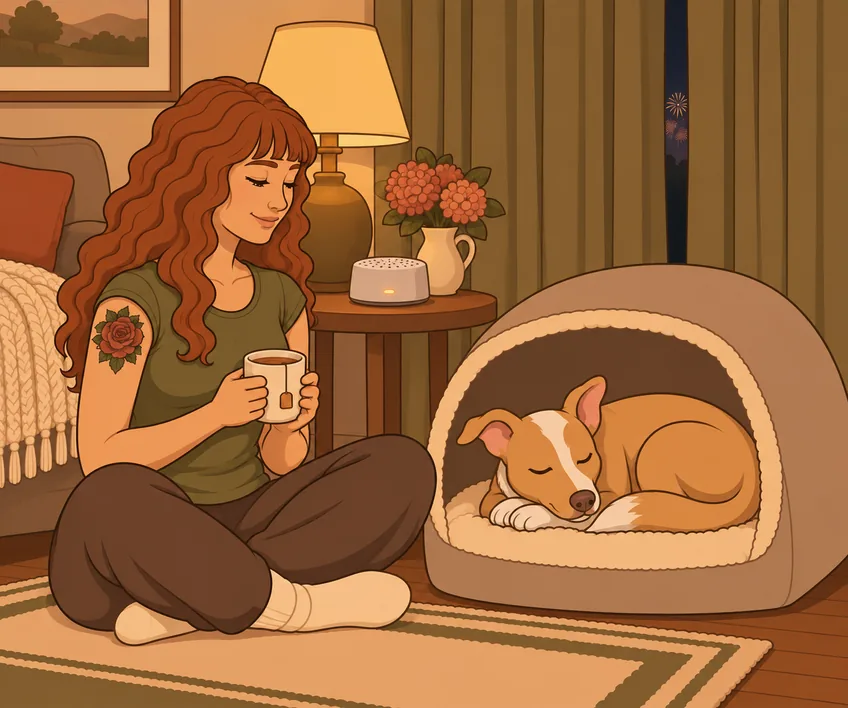
What you should not do is force it. If your dog wants to be touched, touch him. If he wants to be under the bed, let him be under the bed and do not drag him out to reassure him. The thing to follow is what your dog is actually asking for, which on a bad night is usually a dark enclosed space and someone nearby who is not panicking.
What actually helps on the night?
Most of it is dull and environmental rather than clever.
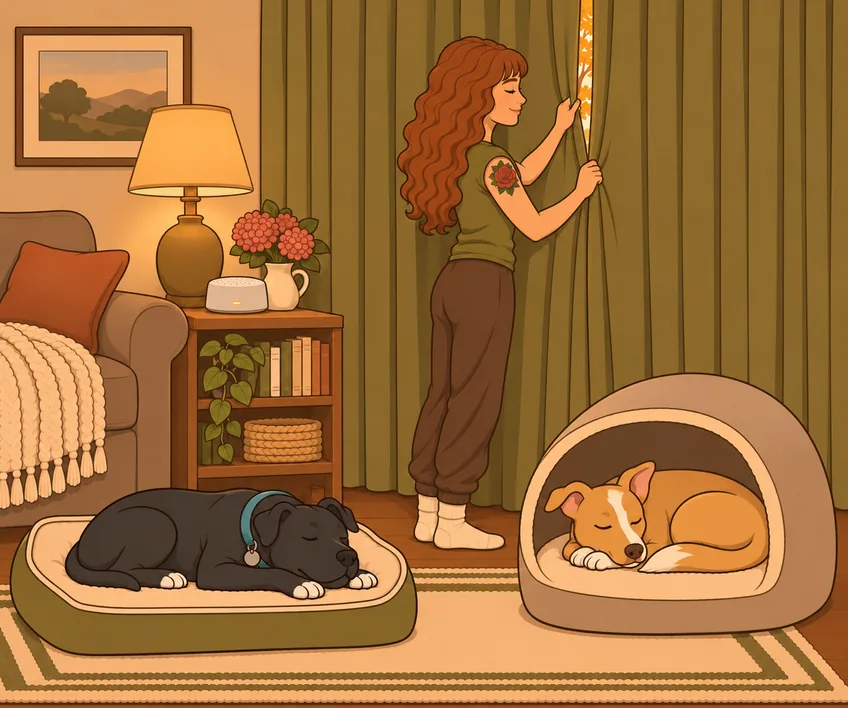
- Pick the room before the evening starts. The one furthest from the street, with no window onto it, ideally with a door. A bathroom or an interior hallway often beats a bedroom.
- Cover the sound rather than trying to drown it. A sound machine, a fan, or the television at a normal volume. The goal is to blur the edges of the bangs, not to be louder than them. A sound machine was one of the three things a trainer gave us that actually changed our house, and it is the one I would start with.
- Close the curtains before dark. The flashes matter more than people expect, and a dog watching the window is rehearsing the fear rather than recovering from it. If your dog patrols the glass generally, the window itself may be a bigger problem than the noise.
- Let him hide, and make the hiding place better. A crate with a blanket over three sides, a bed pushed into a closet. Hiding is coping, not giving up.
- Feed earlier than usual. A frightened dog will not eat, and a dog who has not eaten since lunchtime is worse off at midnight.
- Last walk early, in daylight. The last thing you want is to be outside when the first one goes off.
- Check the microchip details and the collar tag now, not on the night. More dogs go missing on firework nights than on any other night of the year, and almost all of them bolted from a door or a yard. If your chip is still registered to an old address, this is the week to fix it.
Keep him inside, even in a fenced yard. A panicking dog will get over or under a fence he has never tested before.
What should I ask my vet?
Three questions, and the first one matters more than the others.
Could this be pain? Researchers at Lincoln found that dogs with noise sensitivity and underlying musculoskeletal pain behaved differently from noise-sensitive dogs without pain. The pain group avoided far more broadly, whole areas rather than the one spot where something bad happened, and their fear started on average around four years later in life. If your dog's noise fear appeared or worsened in middle age rather than being there all along, a pain assessment is a reasonable thing to ask for, and it is not the first thing most people think of.
If we use medication, what and when? There is an FDA-approved treatment specifically for noise aversion in dogs, and several off-label options vets use. Your vet decides which, not the internet. The part worth knowing as an owner is the timing: medication for this generally works best given before the noise starts, not once your dog is already panicking. That means a plan made in advance, not a phone call at nine in the evening.
Is acepromazine the right choice here? Ask this one directly. The European Society of Veterinary Clinical Ethology has a position statement on it: acepromazine lacks anxiolytic properties and is not suitable for managing acute phobic reactions in dogs. In plain terms, it can leave a dog sedated and unable to move while still fully afraid, which is a worse situation than the one you started with. It is still prescribed for this, so it is worth asking about rather than assuming.
Nothing here is veterinary advice and none of it replaces an actual examination. Serious noise fear warrants a veterinarian or a credentialed behavior professional, and the night itself is not the time to start looking for one.
What can I do before the next one?
The honest answer is that the work that changes this happens in the months when there is nothing to be afraid of.
Desensitisation and counter-conditioning, done properly with recorded sound at a volume your dog barely notices and built up over weeks, has the best evidence behind it. It is slow, it is boring, and it does not work if you rush it, which is why most people who try it in the last week of December conclude it does not work at all.
So the realistic plan is two-part. Get through this one with the room, the sound cover, the curtains and a vet conversation. Then start the slow work in February, when the next firework night is eleven months away and there is no deadline making you hurry.
One more thing worth saying. A dog who spends an evening terrified does not simply reset the next morning. Stress hormones take days to clear, and a dog who had a bad night is likely to have a lower threshold for everything else for the rest of that week. If the walks are worse on the second of January, that is not a setback. That is the night before, still working its way out.
Sources. Blackwell, Bradshaw and Casey, "Fear responses to noises in domestic dogs: Prevalence, risk factors and co-occurrence with other fear related behavior", Applied Animal Behavior Science, 2013. Lopes Fagundes, McPeake, Mills et al., Frontiers in Veterinary Science, 2018. ESVCE position statement on medications for acute phobic states in dogs.