When the window is the problem
If your dog patrols the front window and erupts at every passing dog, the cheapest fix is usually not training. It is the glass.
A lot of reactive behavior gets rehearsed at home, through a window, for hours a day, while nobody is really doing anything about it.
The pattern is familiar. Your dog hears something, runs to the front window, barks at whatever is passing, and the thing passes. From your dog's side, the barking worked.
Then it happens again tomorrow, and the day after that, several times a day, for years. Behavior that gets practiced gets better, whether or not you want it to.
Why does my dog bark at the window?
Because it works, from your dog's point of view. Your dog barks, the thing outside moves on, and the pattern gets reinforced several times a day.
There is a reflex to treat every behavior problem as a training problem. Often the faster and cheaper move is to change the environment so the behavior cannot happen at all. The barking needs something in view to aim at, so if you take away the sightline there is usually nothing left to rehearse against.
Window film
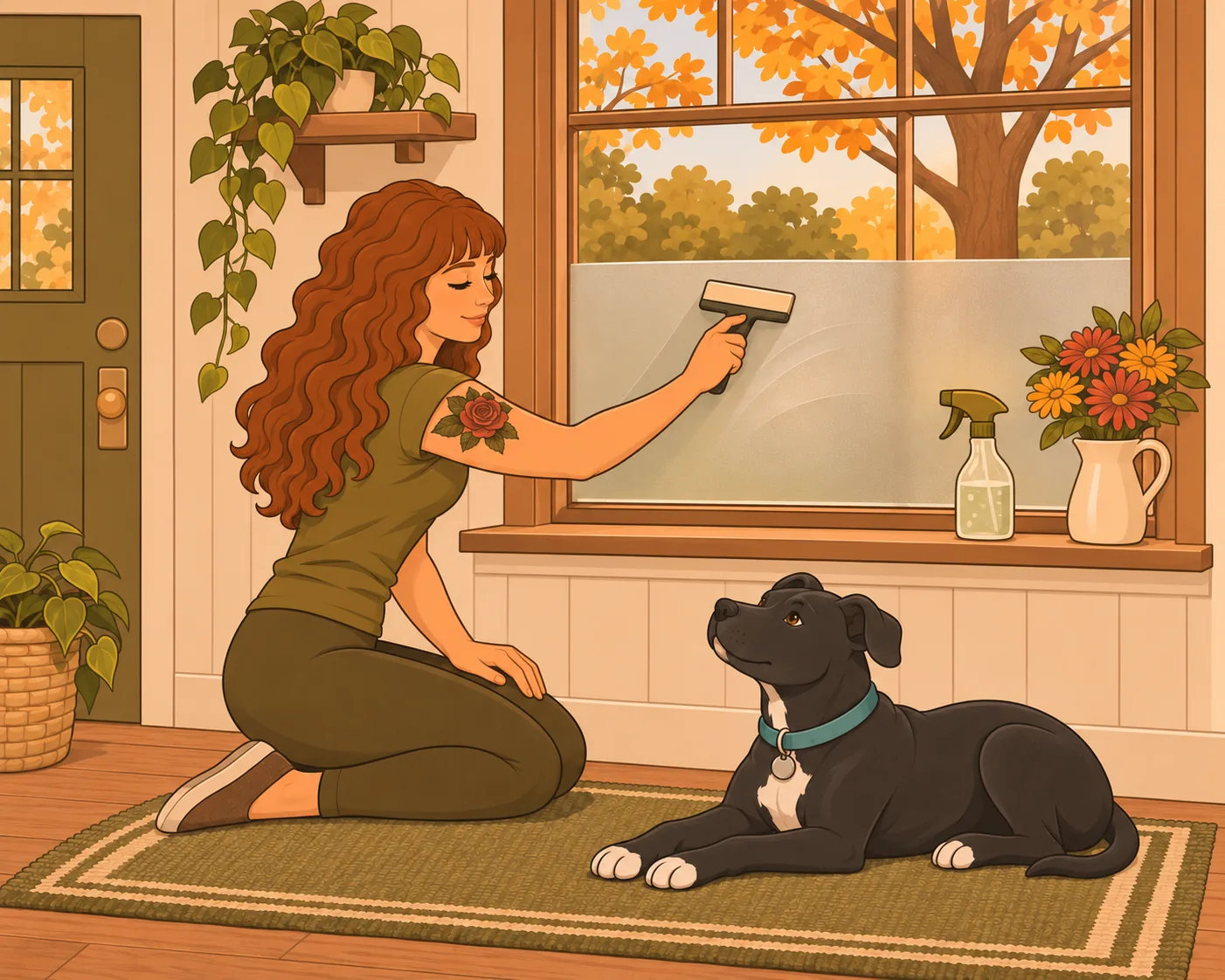
Static-cling or adhesive privacy film on the lower part of the window blocks the sightline and still lets the light through. It costs very little, goes on with a spray bottle and a squeegee, and comes off again if you rent.
This is the one I can speak to directly. Film on our front window was one of three things a trainer gave us that actually moved the needle, and it was by a wide margin the cheapest.
Two practical notes. Measure at your dog's eye level standing rather than sitting, and go a few inches above that, because dogs are resourceful. And frosted or rice-paper patterns diffuse better than tinted film, which can still leave usable silhouettes.
Rearranging the furniture
Sometimes the fix is free. The couch under the bay window is a viewing platform, and moving it turns the window from a lookout into a wall.
Closing off the room
A baby gate across the hallway takes the front of the house out of play during the hours the street is busy. Less elegant than film, and about as effective.
Will blocking the window fix leash reactivity?
It will not, and it is not meant to.
What it does is remove the rehearsal, which matters more than it sounds. It takes away dozens of repetitions a week that were quietly making the pattern stronger.
It teaches your dog nothing about dogs, so if you also have reactivity on walks, you still have that to work on.
One thing worth keeping in mind is the side effect people do not expect. A dog who spends the day scanning and alerting is not resting, and a tired-but-not-rested dog has a lower threshold for everything else. The house tends to get quieter in general, not only at the window.
Do calming diffusers, sprays and wraps work?
The evidence is weaker than the marketing.
There is a large market of diffusers, sprays, wraps and sound machines sold for this. Some owners report they help. The research is mixed, and I think this category overstates what the evidence supports more than most.
A sound machine is the one I would separate out, because it is doing something concrete rather than pharmacological. It covers the noises that start the whole sequence, which puts it in the same bucket as the film: environmental, not treatment.
If you do try something, change one thing at a time so you can tell what did what. Blocking the window and starting a diffuser in the same week tells you nothing about either.
Serious reactivity still warrants a veterinarian or a credentialed behavior professional. None of these products are a substitute for that.

What should I try first?
- For three days, note when your dog goes to the window and what set it off. You will probably find a narrow band of time that accounts for most of it.
- Block the sightline, and give it two weeks.
- Compare the two weeks against those first three days.
If incidents at home drop and walks are unchanged, you have separated two problems that were tangled together. Both get easier to work on once they are apart.